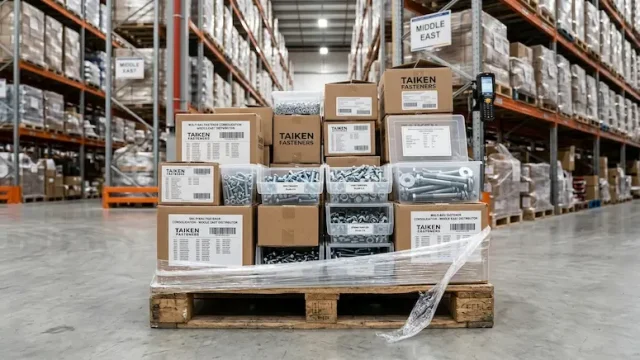
A hardware distributor in the Gulf asked us to put his own brand on a line of hex bolts and drywall screws. We coordinated the carton specs, the barcodes, and the label approvals before the first production run. The order went clean — but only because the packaging was treated as its own project, not as an afterthought tacked onto the last week before shipment.
Private label is how a middle-market importer stops being a price-taker. Put your name on the box and you’re building a brand your customers reorder from, instead of reselling whatever’s cheapest this month. But packaging is also the easiest place to burn a container: a wrong barcode, a label that violates the destination’s language rules, or a carton that doesn’t cube out the container, and your margin disappears into rework, re-labeling, or worse, a rejected shipment.
Packaging is a spec, not an afterthought
Treat your packaging with the same care as the fastener itself. Three elements define a private-label program, and all three have to be locked before production starts.
Carton specs. The carton isn’t just a box — it’s a logistics decision. Carton dimensions determine how many boxes cube out a 40′ HQ, which sets your freight cost per unit. A carton that’s 2cm taller than it needs to be can cost you thousands over a full container program. Decide inner box + carton, or carton-only, based on how your customer sells at retail versus bulk.
Barcodes. For retail or wholesale distribution, you need a scannable code on the carton — EAN-13 for most of the world, UPC for North American retail. The barcode has to be registered to your brand, printed at the right contrast, and placed where a warehouse scanner can actually reach it. A barcode that’s the wrong symbology or too low-contrast scans as “not found,” and a warehouse that can’t scan it is a customer who won’t reorder.
Labels. The label is where destination-market rules bite. A label with the wrong language, a missing country-of-origin statement, or an incorrect quantity declaration can get a pallet held at customs. Every market has its own requirements, and they change.
| Packaging element | What to lock down | Where it usually fails |
|---|---|---|
| Carton dimensions | Match to container cube, pallet size | Oversized boxes kill freight efficiency |
| Inner box + carton | Retail-ready or bulk only | Wrong pack-out for the sales channel |
| Barcode type | EAN-13 vs UPC | Wrong symbology, won’t scan at retail |
| Barcode placement | Flat, scannable, standard height | Curved surface or low contrast |
| Label language | Destination market requirements | Missing Arabic label for GCC retail |
| Country of origin | “Made in China” statement | Omitted or buried on the label |
| Quantity / weight | Accurate per carton | Declared vs. actual mismatch at customs |
The retail-versus-wholesale split
The pack-out decision comes down to how the product sells on the other end, and it’s the first question to ask your customer. A retail-ready line needs the small inner box — a branded box of 100 or 500 screws with a barcode on each one, shelf-ready and priced. A wholesale line can ship bulk cartons of 5,000 or 10,000 pieces with one barcode on the outer carton and nothing else.
Getting this wrong cuts both ways. Pack wholesale product in retail inner boxes and you’re paying for packaging your customer has to strip off. Pack retail product in bulk and your customer has no way to put it on a shelf. The split also changes the carton dimensions and the pallet pattern, so it feeds straight back into the freight cost. Decide the channel first, and the packaging decisions mostly make themselves.
Label rules are regional, not universal
For the GCC, labeling is where a lot of first-time private-label programs stumble. Most Gulf markets require Arabic on the label for consumer-facing product, alongside the English — and the requirement isn’t uniform. Saudi Arabia enforces its own conformity and labeling rules through the SABER/SASO system; the UAE and Kuwait have their own schemes. A label that’s English-only and passes in one market can fail in the next.
The practical rule: confirm the labeling requirement for the specific destination country before the first print run, and keep a native speaker in the loop for the Arabic wording. A machine translation on a label is a fast way to look unprofessional on a shelf, and a missing Arabic line is a fast way to a customs hold.
The approval loop is the whole game
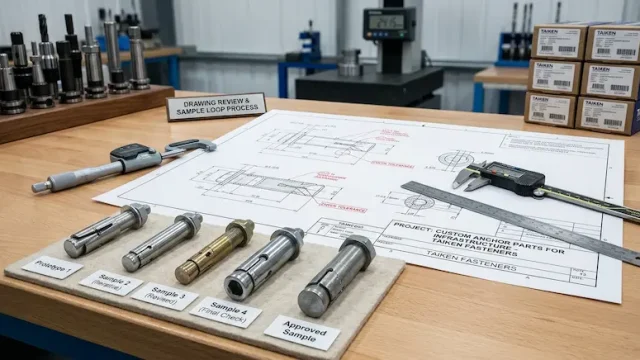
The single most important habit in private label is this: approve a physical sample of every label and every carton before the production run. Not a PDF mockup — a printed sample, photographed on the actual box.
The sequence that works is simple. Design the artwork, get a digital proof, then print one physical sample of each label and carton and get it signed off by whoever owns the brand. Only then release production. When a distributor sends you artwork changes in week three of a four-week run, that’s where mistakes happen — a file overwritten, an old version printed, a barcode that was correct two revisions ago.
Why buyers do this
Private label pays off in two ways. First, it protects your margin — a branded line can’t be price-compared against the identical unbranded product down the street. Second, it builds reorder loyalty; your customer comes back to your brand, not to whoever was cheapest that week. For a distributor moving several containers a year of a commodity like drywall screws, that brand is the only durable asset in the transaction.
The work is front-loaded, but it’s predictable. Carton specs, barcodes, and label approvals are all decisions you make once and then repeat. Get them right on the first SKU and every SKU after it is easier.
Print quality and carton material
Two production details decide whether the brand looks premium or cheap on the shelf. The first is print. A one-color stencil print on a brown carton is economical and fine for wholesale; a multi-color flexo or offset print on white board looks like a real brand, and the difference shows up at retail where the box has to sell itself. Match the print spec to the sales channel, and don’t pay for four-color artwork on a carton that will never see a shelf. The second is board. A three-ply carton is fine for light screws; a five-ply carton handles heavy bolts without collapsing in the container stack. Under-spec the board on a heavy product and you’ll get crushed cartons and angry warehouse managers, even if the fasteners inside are perfect.
Before your first private-label run
- Register your barcodes before you order cartons. The code has to exist and be assigned to your brand before it’s printed.
- Approve a physical label sample, not a screen mockup. Print it, place it on the carton, photograph it, sign off.
- Lock carton dimensions with the freight forwarder, not just the factory. The factory boxes to spec; the forwarder cubes the container.
- Confirm the destination’s labeling rules — language, country of origin, quantity — before the first print run, not after.
- Freeze artwork changes at a cutoff date. Revisions after the cutoff are a new order, not an edit.
Private label is how a hardware importer stops competing on price alone. Do the packaging work up front, and the brand actually sticks.