Most Middle East distributors don’t have a fastener problem. They have a vendor problem. Ask a distributor in Dubai or Riyadh how many suppliers feed their bolts, nuts, washers, screws, and anchors, and the answer is usually six or seven — sometimes more. Each one has its own pricing, its own mill certificates, its own inspection report, and its own idea of what “good enough” looks like. The parts are fine. The chaos around them is what eats the margin.
Consolidation is the fix, but it’s a discipline, not a one-time decision. Here’s how a mixed-container program actually works, what it saves, and where you have to be careful.
What multiple suppliers really cost
The invoice price per kilogram looks cheap when you’re buying from six vendors. It’s the invisible costs that add up:
- Inspection variance. Six suppliers means six quality standards. One batch of M8 nuts might be within tolerance, the next marginally out, and you don’t catch the difference until a customer complaint. A single inspection standard across one vendor removes the variation at the source.
- Document overhead. Every supplier sends its own MTCs, packing lists, and certificates. Your customs broker in Jebel Ali has to reconcile six sets of paperwork instead of one. That’s time, and time is demurrage.
- Logistics friction. Partial shipments, split bills of lading, and three different forwarders. Consolidating SKUs into fewer containers cuts the freight cost per unit and the number of moving parts.
- No single point of responsibility. When a mixed order ships wrong, each supplier blames the others. One vendor holding the whole program has nowhere to hide.
The market backdrop makes consolidation worth taking seriously. The GCC industrial fasteners market runs into the hundreds of millions of USD annually, and the UAE is the region’s largest fastener importer — it brings in over USD 350 million a year from suppliers in China, India, the US, Germany, the UK, and Taiwan, according to Straits Research. A distributor sitting inside that flow, managing six suppliers by hand, is leaving coordination money on the table.
What a consolidated program looks like
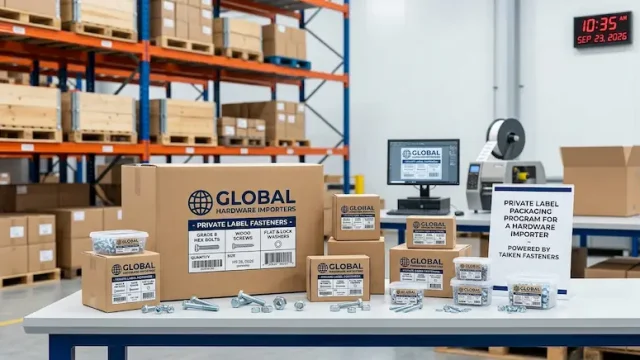
The idea is simple: one supplier carries your full range — bolts, nuts, washers, and screws — and ships them together in a mixed container, on one set of documents, under one quality standard. You stop managing vendors and start managing a program.
| Dimension | Dispersed buying (6+ suppliers) | Consolidated program |
|---|---|---|
| Quality standard | Varies per supplier | One inspection standard, one AQL |
| Documents | Six sets of MTCs and packing lists | One set per container |
| Freight | Partial loads, split B/Ls | Full container, one B/L |
| Responsibility | Diffuse, finger-pointing | Single point of contact |
| Price leverage | Small orders, weak terms | Volume across SKUs, better terms |
| Reorder process | Six POs, six lead times | One PO, one schedule |
The quality point deserves emphasis, because it’s the one that compounds over time. When every SKU runs through the same inspection checklist — same hardness checks, same coating checks, same sampling plan under ISO 2859-1 — you stop discovering problems at your customer’s warehouse and start catching them at the source. That consistency is worth more than a few cents a kilo.
The savings show up in three places
The buyers who consolidate usually see the payoff in three specific line items, and none of them is the unit price.
First, freight. A mixed container that cubes out properly costs less per kilo than three partial shipments — and you avoid paying LCL consolidation fees and split-bill charges. Second, inspection. One inspection event for a consolidated container beats six separate visits, and it’s more meaningful, because one standard is being applied to the whole range. Third, administrative time. One set of documents through one broker clears faster, and faster clearance is cheaper clearance.
The unit price might even drop a little once the supplier sees the full annual volume across SKUs — but treat that as a bonus, not the reason. The durable savings are in freight, inspection, and admin.
The risks you have to manage
Consolidation isn’t free of risk, and pretending otherwise is how programs fail.
The big one is single-vendor dependence. Put your whole range with one factory and you’ve concentrated your risk. The answer is to consolidate programs, not bet the company — keep a qualified backup supplier for your top-moving SKUs, and audit your primary vendor like a partner, not a one-off transaction.
There’s also a capability filter. Not every factory makes bolts, nuts, and washers well. A supplier that’s strong in hex bolts may outsource the washers, and then you’ve quietly reintroduced the quality variance you were trying to kill. Ask what’s made in-house versus sourced, and inspect the sourced items too.
Finally, don’t consolidate for its own sake. If a specialist makes a niche part far better and the volume justifies the extra paperwork, keep it separate. Consolidation is about the commodity core of your range, not every last SKU.
Reordering gets easier — if you build the system
The quiet benefit of consolidation is that reordering stops being an event and becomes a rhythm. When one supplier holds your range, you can set reorder points per SKU, attach your own internal part numbers, and turn a monthly scramble into a standing order that tops up what’s low. A distributor who consolidates and then still reorders by hand, SKU by SKU, is leaving half the benefit on the table. Build a simple SKU table — your part number, the supplier’s part number, the spec, the reorder point — and the whole program runs on that one document.
The transition is also the right moment to clean up your specs. Most distributors carry legacy line items with vague descriptions — “bolt, M10, galvanized” — that different suppliers have interpreted differently over the years. Consolidation forces you to write each spec once, properly, with grade, finish, and standard. Do that work and you’ll stop the slow drift that comes from six vendors each guessing what you meant.
How to run the transition
- Map your current spend before you move anything. Which SKUs, which suppliers, what volume, what defect history. You can’t consolidate what you haven’t measured.
- Pick the core range first. Start with your highest-volume commodity SKUs — hex bolts, nuts, washers — and consolidate those before touching the long tail.
- Agree one inspection standard up front. Put the AQL, the hardness and coating checks, and the documentation format in the purchase agreement, not in a later email.
- Confirm in-house versus sourced for every SKU. Consolidation only removes variance if the supplier actually controls the parts.
- Keep a backup for the top movers. A second qualified source for your best-selling SKU is cheap insurance against a single point of failure.
- Run a pilot container first. One mixed container proves the logistics, the documents, and the inspection flow at small scale — and gives you the numbers to justify moving the whole range.
- Give the program two or three containers before judging it. The freight benefit lands in the first shipment, but the inspection and administrative savings compound as the old vendors’ overhead drops away.
A consolidated program turns a distributor’s fastener supply from a collection of transactions into a system. Fewer suppliers, one standard, one set of documents, one point of responsibility. The kilos were never the problem — the coordination was.