You’ve just received a container from your supplier in Zhejiang. Inside the document folder that came with the bill of lading there’s a stack of mill test certificates — MTCs. Your customs broker in Port Klang stamps them, your client in Kuala Lumpur asks you to forward them, and you do, without opening a single page. Then the site engineer calls: “Where’s the heat number for these A325 bolts?” You don’t know. The whole delivery just went on hold.
If you’ve imported fasteners for a few years, you’ve been in some version of this conversation. The MTC is the one document every buyer asks for and almost nobody actually reads. That’s a problem, because it’s also the document that decides whether your cargo clears an inspection — or gets rejected on the spot.
What an MTC actually is
A mill test certificate is the steel mill’s written confirmation of what went into your product and how it performed. When a Chinese factory rolls a coil of wire rod and cuts it into M8 bolts, the mill records the heat number — the batch identifier that traces back to a specific furnace melt — along with the chemical composition and mechanical test results for that heat.
The industry splits these into two grades you’ll see quoted on RFQs all the time. A 3.1 certificate under EN 10204 is issued by the mill’s own quality department. A 3.2 certificate is the same document, but independently verified by a third-party inspector. For most commercial fasteners, 3.1 is standard. For structural bolts going into a GCC project — tower cranes, steel frames, oil and gas flange joints — you’ll usually be asked for 3.2, or a COC (Certificate of Conformity) on top of it.
Here’s the thing: an MTC is not a coating certificate, and it’s not an inspection report. If your parts are hot-dip galvanized, the HDG thickness and adhesion come on a separate coating report. Too many buyers ask for “the MTC” and think it covers everything. It doesn’t.
The five fields that matter
You don’t need to be a metallurgist to read an MTC. You need to check five things, and most of them take less than a minute.
| Field on MTC | What it tells you | Red flag to watch for |
|---|---|---|
| Heat number / batch no. | Traces the melt back to the mill’s records | Same heat number across two different suppliers’ certificates |
| Chemical composition | C, Mn, Si, P, S content within spec limits | Values typed in a clean row that all sit exactly on the limit |
| Mechanical properties | Tensile, yield, elongation, hardness | Numbers that look copied from a catalog instead of a test log |
| Standard / grade cited | DIN 933, ASTM A325, ISO 898-1, etc. | Standard quoted doesn’t match the head marking on the bolt |
| Surface treatment | Usually NOT on the MTC — separate report | A zinc-plated order with no separate coating report at all |
The heat number is the one I always tell buyers to check first. It’s the only field that physically connects the document to the metal. If the heat number on the certificate doesn’t appear on the product label or the box, you have no way to prove this certificate belongs to this cargo.
The chemistry row deserves a quick read too, even if you skip the rest. Carbon is what gives steel its strength — a Grade 8.8 bolt needs enough carbon (plus manganese) to hit 800 N/mm² tensile, and a Grade 10.9 needs more, with the right heat treatment. Phosphorus and sulfur are the ones you want low, because both make the steel brittle. If those two numbers creep up, the bolt can pass a visual check and still crack under load. You don’t need to memorize limits; you need to notice when a number sits outside the range the standard allows.
Three ways MTCs go wrong
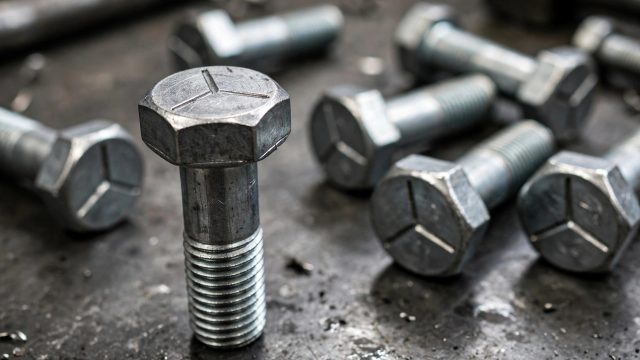
The certificate doesn’t match the marking. A Grade 8.8 bolt per DIN 933 is marked “8.8” on the head. An ASTM A325 Type 1 structural bolt is marked “A325”. If the MTC says one grade and the head says another, the certificate is useless — even if both documents are perfectly genuine. This happens constantly when a factory runs one spec for two customers and mixes up the paperwork.
The same heat number shows up everywhere. A single furnace heat can be thousands of kilos of wire rod, so one heat number feeding many small orders is normal. But when the same heat number appears on certificates from two different factories, someone is copying. Genuine mills issue unique heat identifiers; a photocopied MTC is the fastest way to get flagged at a Saudi or UAE port inspection.
The standard is quoted wrong. Buyers in the Gulf routinely ask for ASTM A193 B7 stud bolts with A194 2H heavy hex nuts for flange joints. If your supplier’s MTC cites ISO 898-1 instead, that’s not the same product family, and a sharp inspector will catch it. The fix is cheap: put the exact standard in the purchase order, and make the MTC reference the same standard verbatim.
Units and shorthand worth knowing
Two small things trip people up reading these documents. First, the units: tensile and yield show up as N/mm², MPa, or ksi depending on who wrote the certificate. N/mm² and MPa are interchangeable; ksi is not — one ksi is about 6.895 MPa, so a Grade 8.8 bolt at 800 N/mm² is roughly 116 ksi. Second, the shorthand: C is carbon, Mn manganese, Si silicon, P phosphorus, S sulfur, and an HB, HRC, or HV value is a hardness reading, not a typo. You don’t need to convert these in your head — you need to recognize them, so a mismatched unit doesn’t look like a failed test.
The conformity layer on top
In the Gulf, the MTC isn’t the whole story — it feeds into a conformity scheme, and the scheme varies by country. Saudi Arabia works on SABER with a SASO certificate for regulated products; the UAE runs the ECAS/EQM system; Kuwait has its own CoC requirements. The point that catches buyers is that these schemes validate the documents and the batch, not just the mill certificate. If your MTC has a mismatch in the heat number or the standard, the conformity body flags it and the whole clearance stalls. That’s why the five fields matter before the container ever reaches the port.
What to do before you confirm the PI
- Ask for a sample MTC before you place the order, not after the container ships. If a factory can’t produce a clean certificate for a sample, they won’t produce one for 40,000 pieces.
- Confirm whether your buyer needs 3.1 or 3.2, and whether the destination needs a COC. Saudi Arabia, the UAE, and Kuwait each have their own conformity schemes, and a COC from the wrong body is a rejection, not a formality.
- Cross-check the heat number on the MTC against the label on the carton when the goods arrive. Ten minutes at the warehouse beats three days of demurrage.
- Keep your own file. When a project is audited a year later, you’ll be glad the heat numbers were archived instead of lost with the packing list.
- If the order mixes multiple specs — say, structural bolts and standard hex bolts in one container — make sure each line item has its own certificate. One blanket MTC for a mixed container is a red flag by itself.
If your next order involves structural or high-grade fasteners, pull the MTC out and read those five fields before you confirm the PI. It’s the cheapest insurance in the business.