Introduction
A bolt costs a few cents. A failed bolt can cost a structure, a shipment, or a reputation — which is why vetting a fastener supplier in China before the first order matters, and why the cheapest quote is rarely the cheapest outcome.
Fasteners look interchangeable, but they are not. A Grade 8.8 hex bolt and a bolt merely marked 8.8 can look identical on a bench and behave very differently under load. The United States learned this the hard way: the US Fastener Quality Act records Congress’s findings that “millions of mismarked, substandard, counterfeit, and other nonconforming fasteners have been sold in commerce,” and that their use “dramatically increased the risk of equipment and infrastructure failures.” The same Act notes that the lack of traceability of fasteners sold in commerce is “a serious impediment to effective quality control efforts.” [1]
Buyers in Southeast Asia, the Middle East and Central Asia import fasteners in volume for construction, steel structures, oil and gas, power and general industry — applications where a wrong grade or a fake certificate is not a paperwork problem but a safety problem. Whether you are sourcing wholesale fasteners for distribution or buying project quantities for a single job, the vetting process is the same.
This guide is a practical checklist. It covers what to verify before you order, what to inspect while goods are being made, and which warning signs should stop a deal. It is written for importers buying bolts, nuts, screws and custom fasteners in volume — whether you are buying from a bolt manufacturer in China directly or through a consolidator.
1. Start with the standard, not the price
Before you compare suppliers, fix your specification in writing: the product standard (DIN, ISO, ASTM, GB — and GOST where your market requires it), the grade or property class, the material, the dimensions and thread, and the coating. A supplier who cannot confirm all five in writing is not ready for your order.
Take ASTM A193 Grade B7 stud bolts. A193 is the main US standard for bolting in high-temperature or high-pressure service, and B7 is a heat-treated chromium-molybdenum alloy steel with a minimum tensile strength of 125 ksi (862 MPa) for diameters up to 2½ inches. [5] If a supplier offers “B7” without being able to state the material, the heat treatment, or the tensile requirement, you are not buying B7 — you are buying a bolt with B7 written on it.
China’s fastener industry is concentrated in clusters, and the largest is Yongnian in Handan, Hebei — widely described as China’s fastener capital and the largest distribution centre for standard parts in the country. [8] District figures reported in 2026 put Yongnian’s 2025 output at 7.8 million tonnes of fasteners worth 55.16 billion yuan, about 58% of the national market by production and sales volume. [7] The cluster covers the full national fastener catalogue — 12 categories, 289 sub-categories and around 30,000 specifications. [7] That scale helps buyers — most specifications are available locally and mixed orders can be consolidated — but it is also a reason to vet carefully: a cluster this large holds world-class factories and small workshops side by side.
Price comparison only works when the specification is identical. Ask every supplier to quote against the same written spec, and treat a quote that is far below the rest as a question, not a bargain.
2. The factory audit checklist
Use this checklist before the first order — or before the first visit. Each item states what to ask for and the point at which you should walk away.
| # | Check | What to ask for | Walk away if |
|---|---|---|---|
| 1 | Business license | A copy of the business license; confirm the company name, registered address and business scope match the name on the contract and the invoice | The name on the license, the contract and the bank account are three different names |
| 2 | ISO 9001 certification | A current ISO 9001:2015 certificate issued by an accredited certification body; check the scope covers fastener manufacturing and the expiry date | The certificate is expired, the scope is unrelated (for example, trading only), or no certificate can be produced |
| 3 | Material certificates (MTC) | EN 10204 Type 3.1 inspection certificates for the steel used — batch-specific test results tied to a heat number | Only a generic 2.1 declaration, or a certificate with no heat number |
| 4 | In-house testing | A list of testing equipment on site (hardness tester, tensile tester, salt spray chamber, coating thickness gauge) and who operates it | No testing equipment at all; all testing “done by a friend’s lab” with no records |
| 5 | Production capability | Which processes are done in-house (cold heading, thread rolling, heat treatment, coating) and which are outsourced — and to whom | The supplier cannot say where the parts are actually made |
| 6 | MOQ | The minimum order quantity per item, in writing, with any surcharge for small quantities stated | MOQ changes after the price is agreed, or is only given verbally |
| 7 | Lead time | Production lead time per item and the shipping schedule, in writing, with the start date defined (for example, from deposit or from drawing approval) | Lead time is “about two weeks” with no written commitment |
| 8 | Packaging | Export packaging specification: seaworthy packing, marking, labelling, palletisation, and moisture protection for sea freight | Loose bulk packing with no marking for a sea shipment |
| 9 | Export experience | Export markets served, and references you can contact; experience with your region’s standards and documents | No export history at all, or no reference buyer willing to speak |
A note on ISO 9001: the standard — ISO 9001:2015 — sets out the requirements for a quality management system that lets an organisation consistently provide products meeting customer and regulatory requirements. [2] Certification means an accredited body audited the system; it does not guarantee that any single batch is good. Treat it as a baseline, not a verdict — the certificate, the material certificates and the inspection results together are what give you confidence.
3. How to run the audit in practice
A full audit does not have to start with a flight. Work in three steps.
Step 1 — Desktop audit. Collect the checklist documents by email. Verify the business license against the company name on the contract. Check the ISO certificate’s scope and expiry, and confirm the certification body is accredited. Ask for a sample 3.1 material certificate and check that it names the heat number, the grade and the actual test results — not just a statement of compliance.
Step 2 — Sample order. Before a volume order, place a small trial order for the exact items you will buy in volume. Inspect the samples against your specification: dimensions, thread, head marking, coating. Keep one sample from each batch as a reference. A supplier who will not do a trial order, or whose samples differ from the bulk goods, has told you everything you need to know.
Step 3 — Factory visit, or a third-party audit. If the volume justifies it, visit — or appoint an inspector to visit on your behalf. On the floor, look for what documents cannot show: whether the testing equipment is actually on site and in use, whether raw material carries heat-number identification, whether non-conforming product is segregated, and whether production records match what sales promised. If you cannot visit, a pre-shipment inspection by an independent body is the standard substitute — SGS, Bureau Veritas, TÜV and DNV are among the firms commonly used. [6] A supplier who refuses third-party inspection has given you a finding, not an inconvenience.
4. Inspection: what to check before the goods ship
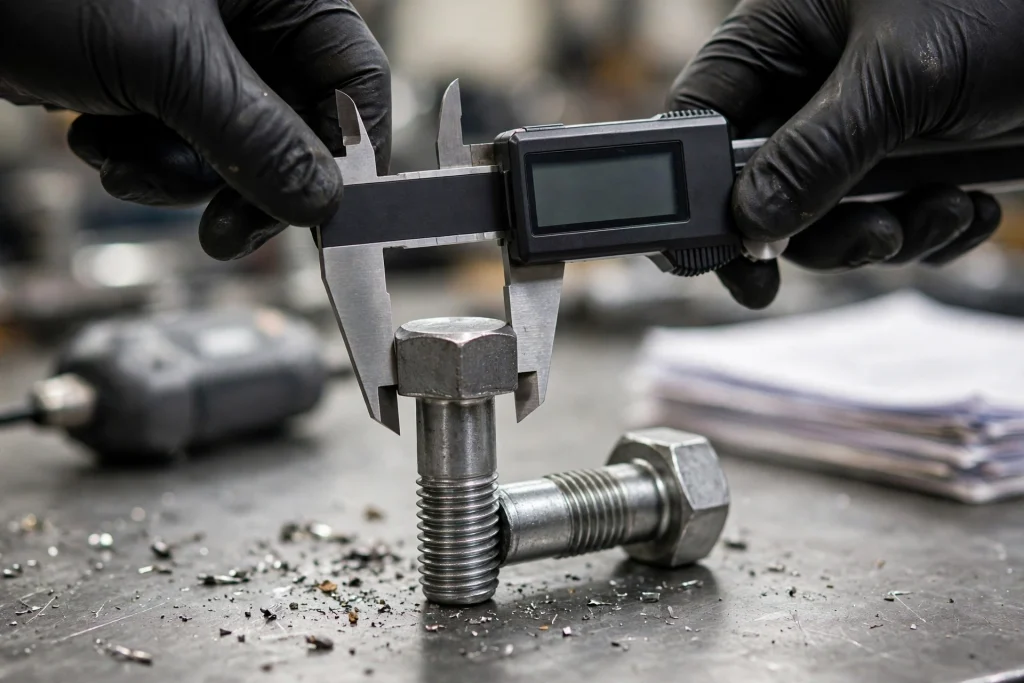
Certificates verify the steel. Inspection verifies the parts. The two are different jobs, and you need both.
- Dimensional checks. Measure a sample against the product standard: diameter, length, thread pitch and head dimensions. A 3.1 material certificate does not cover dimensions — it says nothing about what happened to the steel after it left the mill. [4] Agree the sampling plan in advance, for example inspection per an agreed AQL (acceptable quality level), so there is no argument later about how many pieces were checked.
- Hardness testing. Hardness is the quickest check that heat treatment was done. Compare the result against the grade requirement — for example, the 35 HRC maximum hardness for A193 B7. [5] Too soft means it was not hardened properly; too hard may mean it is brittle.
- Coating checks. Check coating type and thickness against the order. Zinc plating, hot-dip galvanising and other finishes are not interchangeable, and coating thickness affects thread fit. Salt spray testing is the usual corrosion check; agree the test duration in advance.
- Marking and head stamps. Check that grade marks on the bolt heads match the grade ordered, and that the manufacturer’s mark is present and consistent. Mismarked fasteners are one of the classic signs of a nonconforming batch.
- Batch traceability. Every box should be traceable to a heat number, and the heat number on the parts or packaging should match the number on the material certificate. Heat-number mismatches between certificate and marking are a leading traceability failure at incoming inspection. [6] Ask for the mill test certificates before the goods ship, not after.
- Third-party inspection. For high-value or safety-critical orders, have an independent inspector witness loading and check quantity, marking, packaging and documents — standard practice for project buyers, and far cheaper than a rejected container.
5. Red flags
| Red flag | Why it matters |
|---|---|
| Price far below every other quote for the same specification | Usually means a lower grade of steel, skipped heat treatment, or thinner coating |
| No business license, or a license name that does not match the contract | You may have no legal counterparty if something goes wrong |
| ISO certificate expired, or scope does not cover fasteners | The quality system is not audited for what you are buying |
| Only a 2.1 declaration instead of a 3.1 certificate | You have no batch-specific test results for your material |
| Certificate has no heat number, or the heat number does not match the parts | Traceability is broken; the certificate may belong to different steel |
| Refuses third-party inspection or a factory visit | There is something the supplier does not want seen |
| Cannot say where the goods are made | You may be buying from a workshop with no quality control |
| Lead time or MOQ only given verbally, and changing after agreement | The commercial terms are not real |
| No export references, or references that cannot be contacted | No evidence the supplier has served buyers like you |
| Pressure to pay 100% in advance with no inspection clause | You lose all leverage before the goods exist |
One red flag is a question. Two or three together are an answer.
6. Frequently asked questions
Q1: Do I need to visit the factory in China before ordering?
Not always. For standard fasteners in modest volumes, a desktop audit plus a trial order and a pre-shipment inspection is often enough. For custom parts, safety-critical grades, or large first orders, a visit — or an independent audit on your behalf — is worth the cost.
Q2: What certificates should I ask a fastener supplier for?
At minimum: the business license, a current ISO 9001:2015 certificate covering fastener manufacturing, and EN 10204 Type 3.1 inspection certificates for the material in your order. For structural or pressure-service bolting, add the product-standard test reports — for example, the mechanical test results required by ASTM A193 or the equivalent DIN or ISO standard.
Q3: What is an EN 10204 3.1 certificate, and why does it matter?
It is an inspection certificate issued by the material manufacturer, giving the actual chemical and mechanical test results for the specific batch supplied, tied to a heat number and signed by an inspection representative independent of production. [3] A 2.1 declaration only states compliance; a 2.2 certificate gives typical results, not your batch’s results. For load-bearing fasteners, 3.1 is the working minimum; a 3.2 certificate adds a third-party witness. [3]
Q4: What MOQ should I expect from a fastener supplier in China?
There is no single answer — it depends on the product, the material and whether the item is a standard stock line or a custom run. Standard hex bolts are often available in small quantities; custom parts usually carry a higher minimum because tooling and setup must be paid for. Get the MOQ per item in writing before you agree a price, and ask what changes if you consolidate several items into one order.
Q5: How can I check whether a supplier is a real factory or a trading company?
Ask for the business license and check the business scope; ask which processes are done in-house and where; request a video call from the factory floor; and ask for the addresses of the plants that will make your goods. A trading company is not automatically a bad partner — many buyers prefer one that consolidates several factories into a single order — but it should be open about it, and its factories should pass the same checks.
Q6: Should I use third-party inspection for every order?
For trial orders and low-value repeat orders, your own incoming inspection may be enough. For first orders, safety-critical grades, or large shipments, independent pre-shipment inspection is standard practice and inexpensive relative to the value at risk. Put the inspection clause in the contract before you pay the deposit, not after the goods are made.
7. A short note on how Taiken works
Taiken is based in Yongnian, Handan — the fastener cluster described above — and consolidates bolts, nuts, screws, washers and custom parts from qualified factories in the area into one order, one quality standard and one shipment. [9] Material heat numbers are tracked and samples kept per batch; orders go through dimensional, hardness, tensile and coating checks, with certificates tied to the factory that made the goods, and third-party testing can be arranged on request. [9]
If you would like a quote, send your standard list, bill of materials or drawing, with the standard, size, material and quantity for each item. Taiken confirms missing details before quoting and usually replies within 24–48 hours. [9]
Sources
- U.S. Fastener Quality Act, 15 U.S.C. § 5401 — Congressional findings on mismarked, substandard and counterfeit fasteners and the lack of traceability: https://law.justia.com/codes/us/1996/title15/chap80/sec5401/
- ISO 9001:2015, Quality management systems — Requirements (ISO/TC 176): http://committee.iso.org/sites/tc176sc2/home/projects/published/iso-9001-2015.html
- EN 10204 3.1 and 3.2 certificates explained (Sattardas): https://www.sattardas.com/resources/en-10204-3-1-and-3-2-certificates-explained/
- Understanding mill certificates: what to check and why they matter (ForgePoint): https://www.forgepointengineering.com/articles/mill-certificates-en-10204/
- Fasteners for pressure service: ASTM A193, A194 and EN ISO 898 (ForgePoint): https://www.forgepointengineering.com/articles/fasteners-pressure-service-a193-a194/
- Importing precast accessories from China: the EN 10204 certificate that actually protects you (Chontan): https://www.chontan.net/blog/import-precast-accessories-china-quality-guide
- Fasteners in Yongnian, Handan (All-China): https://all-china.com/fasteners-yongnian/
- Handan, a fastener market you can’t ignore! (International Fastener Show China): https://en.afastener.com/wap/infodetail-616.html
- Taiken Fasteners — homepage: https://taikenfasteners.com/