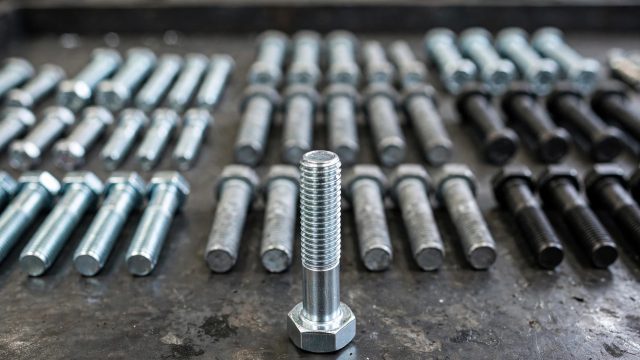
A buyer in Dubai sent me an RFQ that said “DIN 933 hex bolts, M12 x 50, Grade 8.8.” The factory in Zhejiang quoted it back as “ISO 4017, M12 x 50, Grade 8.8.” The buyer thought the supplier was quoting the wrong product and nearly walked. Both were actually describing the same bolt — a fully threaded M12 hex head bolt — under two different standard names. And that confusion is exactly why the question matters.
If you’re importing hex bolts for the Gulf or Southeast Asia, you’ll see DIN and ISO callouts mixed together on RFQs, invoices, and mill certificates every single week. Understanding which is which — and when the difference actually changes the metal — is the difference between a clean order and a rejected batch.
The standards are being replaced, not deleted
Here’s the short history. For decades, DIN (the German institute) wrote the standards everyone in the fastener trade quoted: DIN 933 for fully threaded hex bolts, DIN 931 for partially threaded ones. Over the last twenty years, those DIN standards were withdrawn and replaced by ISO equivalents, largely with identical or near-identical dimensions.
So today:
- DIN 933 (fully threaded) has been replaced by ISO 4017.
- DIN 931 (partially threaded) has been replaced by ISO 4014.
- DIN 934 (hex nuts) has been replaced by ISO 4032.
That said, the old DIN numbers never left the market. Factories still quote them, buyers still write them, and mill certificates still reference them. You’ll see “DIN 933 / ISO 4017” printed together on the same carton. That’s normal, not a mistake.
Where the dimensions actually differ
For the sizes most buyers actually import — M6 through M16 — DIN 933 and ISO 4017 are effectively interchangeable. The differences show up in the details at certain sizes.
| Specification | DIN 933 | ISO 4017 | Practical impact |
|---|---|---|---|
| Thread length | Fully threaded to head | Fully threaded to head | Same for your application |
| Head height | Slightly different at M10, M12 | Spec’d in ISO 4017 | Rarely matters for assembly |
| Width across flats | Same nominal size | Same nominal size | Wrenches fit either |
| Standard status | Withdrawn, still quoted | Current | Both accepted in practice |
| Product grade | A and B | A and B | Match to your tolerance needs |
The differences that actually bite are between the fully threaded and partially threaded versions — 933/4017 versus 931/4014. A fully threaded bolt has thread running all the way to the head; a partially threaded bolt has an unthreaded shank under the head. For a joint that clamps two plates together, partial thread is usually what you want, because the smooth shank sits in the shear plane and the thread only carries the clamping load. Specify fully threaded when you need the bolt to bottom out or clamp over a long grip length.
Here’s the practical trap: on short bolts — say M12 x 40 and under — “partial thread” barely exists, because there isn’t enough shank to leave unthreaded. Below a certain length, DIN 931 and DIN 933 produce nearly the same bolt. Buyers who insist on partial thread for a 30mm bolt are asking for a distinction that doesn’t physically exist at that length. Worth knowing before you argue with a supplier about it.
Grade is a separate decision
Don’t let the standard name carry the strength. A DIN 933 bolt can be Grade 4.8, 8.8, or 10.9. The grade — the mechanical property class under ISO 898-1 — is what tells you tensile strength: 8.8 means 800 N/mm² minimum tensile, 10.9 means 1,000 N/mm². An M12 x 50 “DIN 933” with no grade specified is an incomplete spec, and the factory will happily ship you the cheapest grade they can find.
The grade ladder is worth knowing cold, because it’s the same everywhere you import. Grade 4.8 is low-carbon steel, cheap, for light duty. Grade 8.8 is the workhorse — medium-carbon, quenched and tempered, right for most general and structural applications. Grade 10.9 is higher strength for high-load joints, and Grade 12.9 sits at the top for the most demanding applications, but it’s also the most brittle if not handled correctly. When in doubt, 8.8 is almost always a safe default for general industrial use.
For structural and lifting work, the grade is the whole conversation. In the GCC, ASTM A325 Type 1 and A193 B7 are the callouts you’ll see for structural bolting and oil and gas flange joints — not the DIN/ISO grades. The GCC industrial fasteners market runs well into nine figures in USD annually, and a large share of it is oil and gas and construction spec work, where the grade and the standard are non-negotiable. Know which family your customer’s engineer is working in before you quote.
Pitch and the fine-thread detail
Standard hex bolts use coarse pitch by default — M12 is 1.75mm, M16 is 2.0mm. Fine-pitch versions exist (M12 x 1.25, M16 x 1.5) and are specified for higher clamp loads and better resistance to vibration loosening. If your customer’s drawing says fine thread, say so on the order, because a coarse-thread bolt into a fine-thread nut won’t even start. It’s a detail that costs nothing to confirm and everything to get wrong, especially on pumps and machinery where fine thread is common.
How to verify the standard before you commit
Not sure which standard a customer needs? Ask for the mating part or the assembly drawing, not just a name. A bolt is specified against what it threads into — the nut, the tapped hole, the flange. Once you know the mating part, the standard usually falls out. And when a supplier quotes back a different standard than you asked, confirm whether it’s the withdrawn-DIN-to-ISO equivalent we covered above, or a genuinely different product. Ten minutes of confirmation beats a container of bolts that don’t fit.
Here’s the case that comes up constantly: a buyer orders “hex bolts, M12” and receives full thread, then discovers the application needed partial thread because the joint has a shear plane. The bolts are correct to a standard — just the wrong thread configuration for the load. It’s not a defect, and most suppliers won’t take it back. That’s why “full or partial thread” belongs on every RFQ, in writing, next to the size and grade. The product grade (A or B) is the last piece — A is the tighter tolerance for precision assembly, B is looser and cheaper for general bolting. Match it to the application, and don’t pay for A where B is enough.
What to write on the RFQ
- Quote one standard, and accept its replacement. Write “ISO 4017 (or DIN 933)” and the factory will understand you mean the same fully threaded bolt.
- Always state the grade. Standard + size + grade is the minimum complete spec: “ISO 4017, M12 x 50, Grade 8.8.”
- Say full thread or partial thread explicitly. “M12 x 50” alone doesn’t tell the factory which one you need.
- Match the nut to the same family. A DIN 933 bolt pairs with a DIN 934 nut (now ISO 4032); don’t mix a coarse-thread spec with a fine-thread nut.
- If the application is structural or pressure-related, confirm the standard with the end customer’s engineer before you commit to a container.
- Confirm the pitch — coarse or fine — in the same line as the size. It’s the one detail that turns a correct bolt into a non-fitting one when it’s left off.
The DIN-versus-ISO question isn’t really about which standard is “better.” It’s about writing a spec complete enough that the factory, your inspector, and your customer all read the same bolt. Do that, and the name on the label stops being a problem.