Introduction
A Grade 5 bolt costs a few cents more than a low-carbon bolt that looks exactly like it. The difference only shows up under load — which is why fake Grade 5 bolts are one of the oldest and most dangerous frauds in the fastener trade.
The United States discovered the scale of the problem in the 1980s, when counterfeit fasteners turned up in Army tanks, Navy ships and interstate highway bridges. Congress responded with the Fastener Quality Act of 1990, whose findings record that “millions of mismarked, substandard, counterfeit, and other nonconforming fasteners have been sold in commerce,” and that their use “dramatically increased the risk of equipment and infrastructure failures.” [5] The same Act notes that the lack of traceability of fasteners sold in commerce is “a serious impediment to effective quality control efforts.” [5]
A Grade 5 bolt is the workhorse of automotive, machinery and general engineering work across Southeast Asia, the Middle East and Central Asia — the bolt most buyers order most often, and the one most often faked. This guide explains what a real Grade 5 bolt is, how to read its head marking, the five most common fakes, and a six-step check you can run before a shipment leaves the factory.
1. What a real Grade 5 bolt is
Grade 5 is defined by SAE J429, the standard for inch-series steel bolts, screws and studs. A genuine Grade 5 bolt is made from medium carbon steel — typically AISI 1030 to 1541 or an equivalent grade — that has been quenched and tempered. [10] The heat treatment is what makes it Grade 5: without it, the same steel is just a medium-carbon bolt with a fraction of the strength.
The numbers a Grade 5 bolt must meet depend on its diameter, because larger bolts cannot be hardened as evenly all the way through. The minimum values from SAE J429 are: [1]
| Diameter | Proof load | Yield strength | Tensile strength |
|---|---|---|---|
| 1/4 to 1 inch | 85,000 psi (586 MPa) | 92,000 psi (634 MPa) | 120,000 psi (827 MPa) |
| Over 1 to 1-1/2 inches | 74,000 psi (510 MPa) | 81,000 psi (558 MPa) | 105,000 psi (724 MPa) |
Hardness is the quickest check that the heat treatment was done: a genuine Grade 5 bolt measures Rockwell C25 to C34 (253 to 319 Brinell) in the 1/4 to 1 inch range. [3] Too soft means it was never properly hardened; too hard may mean it is brittle.
The companion specification is ASTM A449, which covers quenched and tempered steel hex cap screws, bolts and studs for general engineering use. A449 is “practically identical in strength and chemistry to ASTM A325 and SAE J429 Grade 5, but covers a larger diameter range” — 1/4 to 3 inches, with minimum tensile strength stepping down to 120 ksi at 1 inch and under, 105 ksi over 1 to 1-1/2 inches, and 90 ksi from 1-3/4 to 3 inches. [2][3] Type 1 A449 bolts are plain carbon steel, carbon boron steel, alloy steel or alloy boron steel; Type 3 is weathering steel. [2] If your drawing calls for Grade 5 above 1-1/2 inches, the correct specification is A449, not J429.
For buyers who work in metric, the nearest equivalent is property class 8.8 under ISO 898-1 — 800 MPa minimum tensile and 640 MPa proof load, against Grade 5’s 827 MPa and 586 MPa. [9] The two are close in strength but not interchangeable: thread forms, dimensions and qualification requirements differ, so always use the grade specified on the drawing and never substitute on the basis of strength alone. [9]
2. How to read the head
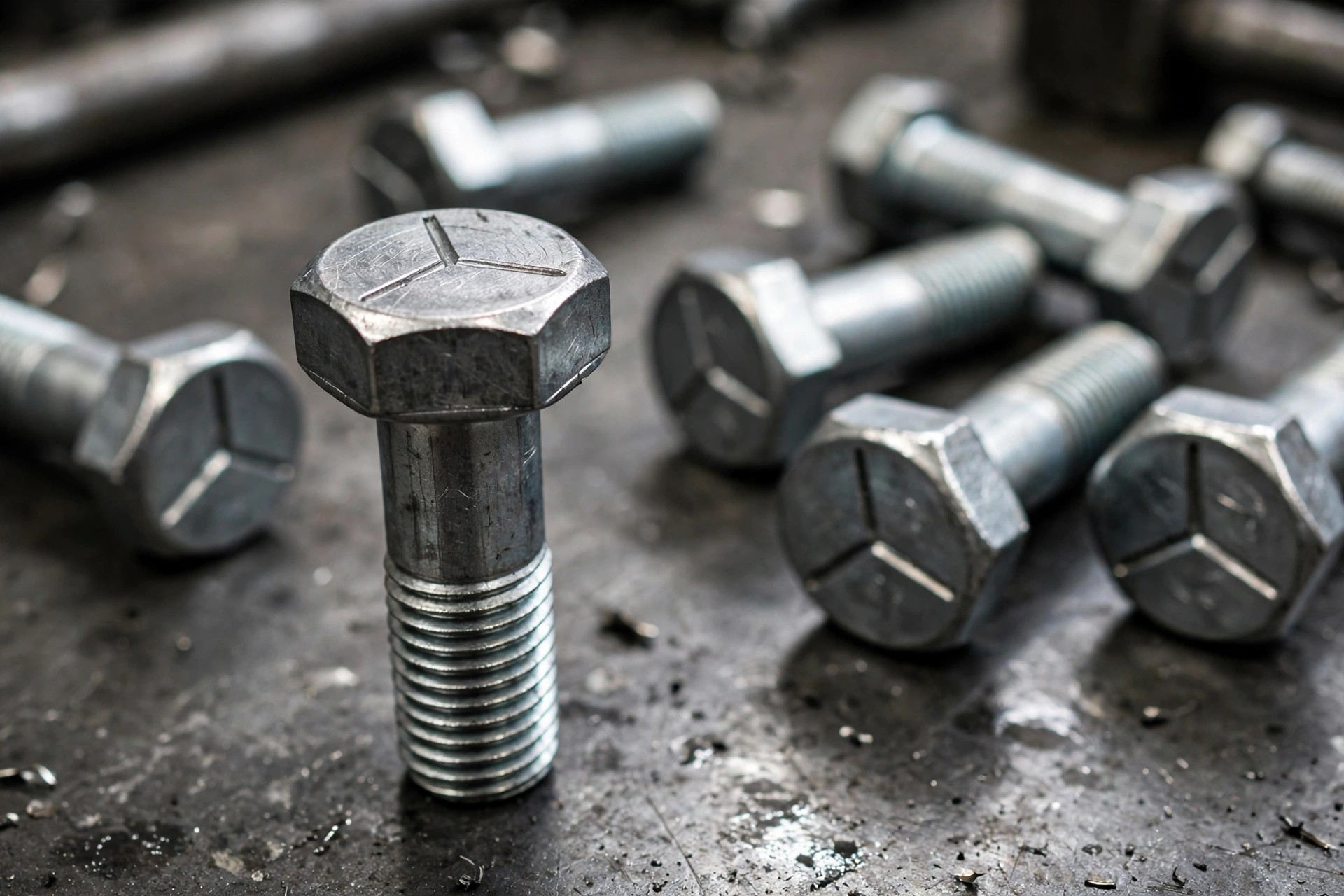
Inch-series bolts do not carry a property class number the way metric bolts do. SAE J429 identifies its grades with radial lines on the head: more lines mean a stronger bolt. A Grade 5 bolt carries three radial lines, spaced 120 degrees apart; a Grade 8 bolt carries six lines, spaced 60 degrees apart; a Grade 2 bolt carries no lines at all. [1]
| Head marking | Grade | Minimum tensile strength | Material |
|---|---|---|---|
| No lines | Grade 2 | 60,000–74,000 psi | Low carbon steel, not heat treated |
| 3 radial lines | Grade 5 | 120,000 psi (up to 1 in) | Medium carbon steel, quenched and tempered |
| 6 radial lines | Grade 8 | 150,000 psi | Medium carbon alloy steel, quenched and tempered |
Two rules keep the reading honest. First, the manufacturer’s identification mark — one to three letters or a symbol — is not a grade line. Do not count it. [1] Second, a bolt with no readable grade mark is not “probably Grade 2”: its identification is incomplete, and it should not be used where a grade is specified. [4]
The mark on the head is the manufacturer’s declaration of what the bolt is — nothing more. Marks are cheap to stamp, so a head marking must always be verified against the lot certificate and a hardness check on a sample. [11] The US Department of Energy’s inspection guide puts it plainly: fasteners that carry a grade mark but no manufacturer mark are “suspect” and require further evaluation, because the standard requires a manufacturer marking. [4]
3. The five most common fakes
| # | Fake pattern | How it is made | How it gives itself away |
|---|---|---|---|
| 1 | Grade 5.2 sold as Grade 5 | Low-carbon boron steel stamped with three lines. At room temperature its mechanical properties are almost identical to Grade 5, so a basic tensile test passes — but after a high-temperature excursion it is susceptible to embrittlement and can fail catastrophically. [12] | Only a chemical analysis or a high-temperature test separates 5.2 from 5; ask for the mill certificate and check the carbon and boron content. |
| 2 | Unhardened medium-carbon steel | The bolt is formed and stamped but never quenched and tempered, skipping the most expensive step. | Hardness well below 25 HRC; a portable Rockwell tester catches it in seconds. |
| 3 | Low-carbon Grade 2 steel with three lines | The cheapest fake: soft steel, correct-looking head, a fraction of the strength. | Fails hardness and tensile tests by a wide margin; threads may deform under a proof load. |
| 4 | Wrong or missing maker mark | Three lines but no manufacturer identification, or a maker mark that changes between cartons in the same order. | A missing maker mark makes the bolt suspect under the Fastener Quality Act framework. [4] Inconsistent marks across cartons mean the lot was mixed from different sources. |
| 5 | Real bolts, fake paperwork | Genuine Grade 5 bolts shipped with a certificate copied from another heat, or a 2.1 declaration of compliance dressed up as a test certificate. | The heat number on the certificate does not match the heat number on the packaging or the parts; the certificate shows no actual test results. |
The pattern across all five is the same: the fraud is invisible on the invoice and obvious on a tester. “Detection of counterfeit fasteners is difficult because the counterfeits look genuine. The only sure way to determine if a fastener meets its specification is to test it.” [13]
4. A six-step check before you pay
You do not need a laboratory to catch most fakes. Work through these six steps on a sample from the actual lot — not on a sample the supplier picked in advance.
Step 1 — Read the head. Count the radial lines: three, evenly spaced at 120 degrees, means Grade 5. Photograph the whole head and keep the grade mark and the maker mark separate in your notes. Check that the lines are crisp and evenly spaced; shallow, uneven or hand-stamped-looking lines are a warning sign.
Step 2 — Check the maker. Ask for the manufacturer’s name and check it against the USPTO Fastener Quality Act registry, which lists registered manufacturer insignia. [4] A maker mark that does not appear in the registry, or a supplier who cannot name the manufacturer at all, is a reason to stop. The US Department of Energy guide recommends exactly this validation step for any suspect fastener. [4]
Step 3 — Test hardness. A portable Rockwell tester is the single best-value tool in fastener inspection. A genuine Grade 5 bolt reads 25 to 34 HRC. [3] Test several bolts from different boxes in the lot, not just one: a mixed lot is the classic sign of a supplier topping up a genuine batch with cheaper stock.
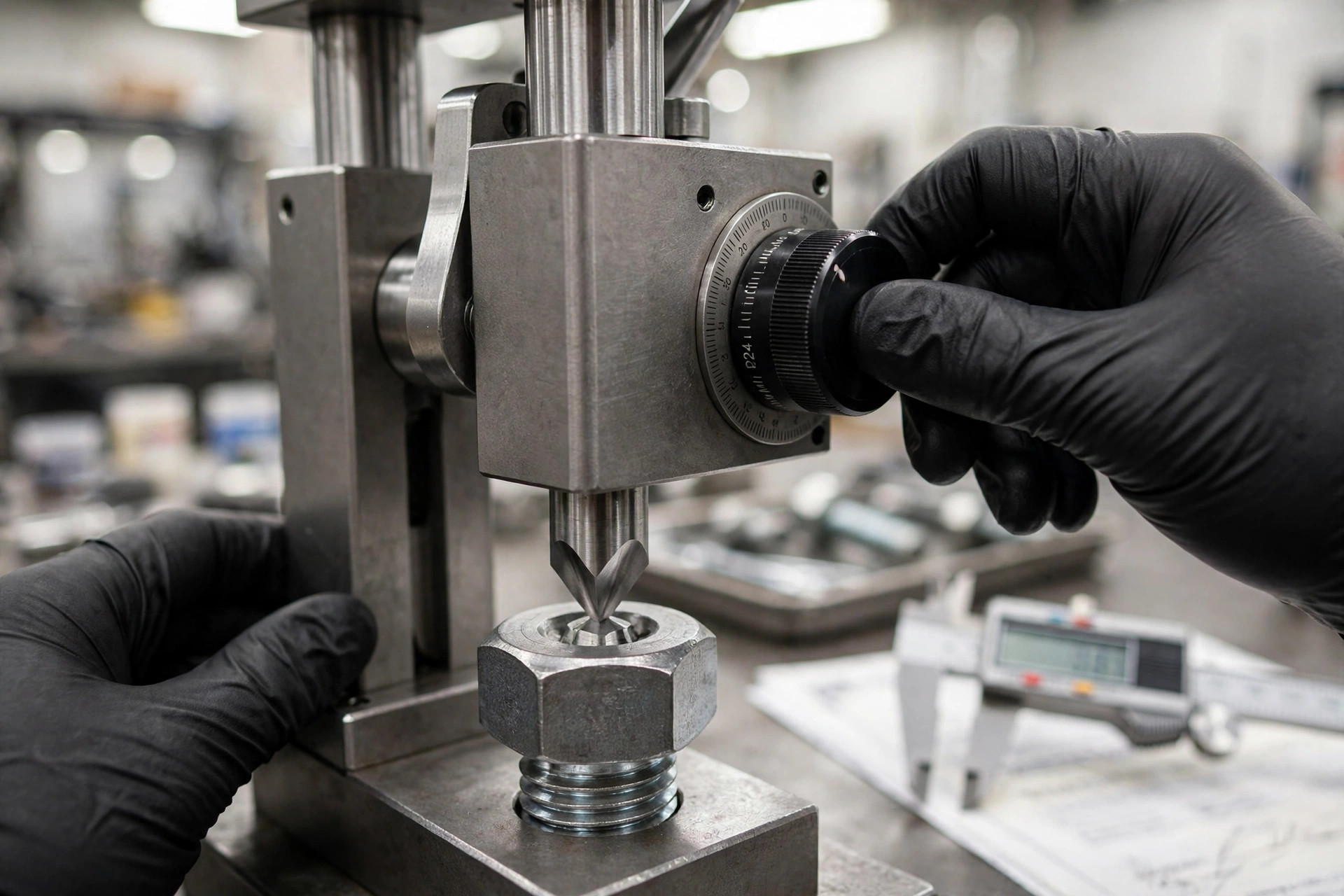
Step 4 — Check dimensions and thread. Measure diameter, length, thread pitch and head dimensions against ASME B18.2.1, and check the thread with GO and NO-GO ring gauges. [7] A bolt that fails dimensional checks was not made to the standard, whatever its head says.
Step 5 — Demand the certificate — and match it. Ask for the EN 10204 Type 3.1 inspection certificate for the material in your order: batch-specific chemical and mechanical test results tied to a heat number. [7] Then check that the heat number on the certificate matches the heat number on the packaging and the parts. A 2.1 declaration only states compliance and gives no test results; it is not a substitute. [7] Acceptance inspection usually follows ISO 3269, which sets how many parts per lot are checked for each feature — agree the sampling plan before the goods are made, not after they arrive. [7]
Step 6 — Send a sample to a lab. For first orders, safety-critical applications or large shipments, have an independent accredited laboratory run a tensile test to ASTM F606, a proof load test and a chemical analysis. [8] A full-bolt tensile test pulls the bolt to failure — it should break in the thread or the shank, not under the head — and a wedge tensile test with a wedge under the head proves the head-to-shank joint is sound. [7] This is the step that catches the Grade 5.2 substitution, which passes every visual and hardness check. Third-party pre-shipment inspection (SGS, Bureau Veritas, TÜV and DNV are among the firms commonly used) is the standard substitute when you cannot test yourself.
One step is a question. Three together are an answer: a bolt that reads right, tests right and traces to a matching certificate is a Grade 5 bolt.
5. Where Grade 5 belongs — and where it does not
Grade 5 is the right default for most commercial, fleet and industrial work: it balances strength, ductility and cost better than any other SAE grade for general-purpose use. [14] Typical applications are engine components, suspension systems and chassis assembly in automotive work; machinery and equipment that see moderate to high loads and vibration; agricultural and construction equipment; and mounting motors to machinery. [10][15]
It is the wrong choice in three places. First, structural steel connections: those are specified under ASTM F3125 (the standard that replaced the withdrawn ASTM A325), not SAE J429, and a Grade 5 bolt is not an A325 bolt even at the same 120 ksi. [10] Second, high-temperature or high-pressure service: that is ASTM A193 Grade B7 territory, a chromium-molybdenum alloy steel with its own qualification. Third, any joint where the drawing names a different grade — never downgrade a specified Grade 8 to Grade 5, and never assume a gold-coloured finish proves a higher grade: a gold surface is often just a zinc chromate finish, and it proves nothing about strength. [4]
When the joint sees dynamic, vibrational or shock loading, Grade 5 is often the smarter call than Grade 8 despite the lower tensile number: its greater ductility absorbs shock that a harder, more brittle Grade 8 bolt cannot. [14] Know the load type before you specify the grade.
6. Frequently asked questions
Q1: Can I tell a real Grade 5 bolt just by looking at the head?
No. Three radial lines say the maker claims Grade 5; they do not prove it. Counterfeits look genuine, and the only sure verification is testing — hardness at minimum, tensile and chemical analysis for certainty. [13] Treat the head marking as a claim to verify, not as proof.
Q2: What is the difference between Grade 5 and class 8.8?
Strength is close: Grade 5 has a minimum tensile strength of 120 ksi (827 MPa) and class 8.8 has 800 MPa. [9] But they belong to different systems — SAE J429 inch series against ISO 898-1 metric — with different threads, dimensions and test rules. They are approximate equivalents, not substitutes: use the grade your drawing specifies.
Q3: My supplier’s Grade 5 bolts have three lines but no maker mark. Is that a problem?
Yes. Under the Fastener Quality Act framework, a grade mark without a manufacturer mark makes the fastener suspect and it requires further evaluation. [4] Ask who made the bolts and check the mark in the USPTO registry; if the supplier cannot answer, do not accept the lot.
Q4: What hardness should a Grade 5 bolt be?
Rockwell C25 to C34 (253 to 319 Brinell) for diameters from 1/4 to 1 inch. [3] Below 25 HRC the bolt was not properly heat treated; above 34 HRC it may be brittle. Test several bolts from different boxes.
Q5: What certificates should I ask for when buying Grade 5 bolts?
An EN 10204 Type 3.1 inspection certificate for the material, with batch-specific test results tied to a heat number — plus the mechanical test results required by SAE J429 or ASTM A449 for the lot. A 2.1 declaration of compliance is not enough, and a certificate whose heat number does not match your parts belongs to different steel. [7]
Q6: When should I use ASTM A449 instead of SAE J429 Grade 5?
When the diameter is over 1-1/2 inches. SAE J429 Grade 5 stops at 1-1/2 inches; A449 covers the same strength levels up to 3 inches, with minimum tensile strength of 90 ksi in the 1-3/4 to 3 inch range. [2] The two specifications are practically identical in strength and chemistry where they overlap. [3]
7. A short note on how Taiken works
Taiken is based in Yongnian, Handan — China’s largest fastener cluster — and consolidates bolts, nuts, screws, washers and custom parts from qualified factories in the area into one order, one quality standard and one shipment. [16] Material heat numbers are tracked and samples kept per batch; orders go through dimensional, hardness, tensile and coating checks, with certificates tied to the factory that made the goods, and third-party testing can be arranged on request. [16]
If you need Grade 5 or ASTM A449 bolts, send your standard list, bill of materials or drawing, with the standard, size, material and quantity for each item. Taiken confirms missing details before quoting and usually replies within 24–48 hours. [16]
Sources
- Bolt grade chart — SAE J429 Grade 5 proof, yield and tensile values by diameter, 3 radial lines head marking (Turn2Engineering): https://turn2engineering.com/charts-and-tables/bolt-grade-chart
- ASTM A449 — Standard Specification for Hex Cap Screws, Bolts and Studs, Steel, Heat Treated, 120/105/90 ksi Minimum Tensile Strength, General Use (ASTM International): https://store.astm.org/a0449-14r26.html
- ASTM A449 bolts — specification summary, hardness 25–34 HRC, chemistry and nut grades (TorqBolt): https://torqbolt.com/astm-a449-hex-cap-screws-bolts-studs-manufacturers-suppliers-specifications
- Suspect/Counterfeit & Defective Fastener Inspection — U.S. Department of Energy (2022), Fastener Quality Act, USPTO registry validation, suspect indicators: https://www.energy.gov/documents/fastener-headmark-list-2022pdf
- U.S. Fastener Quality Act, 15 U.S.C. § 5401 — Congressional findings on mismarked, substandard and counterfeit fasteners and the lack of traceability: https://law.justia.com/codes/us/1996/title15/chap80/sec5401/
- USPTO Fastener Quality Act reference site — manufacturer insignia registry: https://www.uspto.gov/trademarks/laws/fastener-qualityact-fqa/fastener-quality-act-fqa
- How fasteners are tested — quality checks from steel to shipment, tensile, proof load, wedge, hardness, EN 10204 certificates, ISO 3269 sampling (KB Fasteners): https://kbfasteners.in/blog/fastener-testing-and-quality
- What is fastener testing — methods, standards and QC, ASTM F606 tensile and proof load, wedge tensile, hardness (Infinita Lab): https://infinitalab.com/blog/what-is-fastener-testing-guide/
- Bolt grade markings chart — SAE J429 and ISO 898-1, Grade 5 vs class 8.8 equivalence (Calibr): https://calibr.pro/tables/bolt-grade-markings-chart/
- Guide to bolt grades and applications — SAE Grade 5 uses, ASTM A325 withdrawn and replaced by F3125 (Essentra Components): https://www.essentracomponents.com/en-gb/news/solutions/fastening-components/guide-to-bolt-grades-and-applications
- How to choose qualified bolts — head markings, property class, certificates and lot traceability (China Bolt Nut): https://www.chinaboltnut.com/info/how-to-choose-qualified-bolts-103733200.html
- Method of and apparatus for nondestructively determining the composition of an unknown material sample — U.S. Patent 5,052,819, Grade 5.2 vs Grade 5 boron steel and high-temperature embrittlement: https://patents.justia.com/patent/5052819
- Strengths of various fasteners — grade marks, counterfeit detection, “the only sure way to determine if a fastener meets its specification is to test it” (Sportsterpedia / Machinery’s Handbook): http://sportsterpedia.com/techtalk:ref:tools806
- Bolt grades explained — why the strongest option isn’t always right, Grade 5 as the default for commercial and fleet work, ductility under shock loads (Nuts and Bolts): https://nutsandbolts.com/blogs/fastener-guides/bolt-grades-explained-why-the-strongest-option-isnt-always-right
- Best fasteners for automotive & equipment repair — Grade 5 120,000 PSI, three radial lines, match or exceed the original equipment grade (Albany County Fasteners): https://www.albanycountyfasteners.com/fasteners-101-automotive-equipment-application
- Taiken Fasteners — homepage: https://taikenfasteners.com/